Play · Easter
How to run an indoor Easter egg hunt with clue cards
Plan an indoor Easter egg hunt that kids actually solve: how clue chains work, hiding spots by age, safety tips and how to write your own rhyming clues.
A classic egg hunt is over in minutes: everyone runs, someone finds most of the eggs, someone ends up in tears. A clue hunt turns the same morning into a little adventure. Each card sends the children to the next hiding place, and only the final clue leads to the basket. It works in a flat, on a rainy day and with kids of different ages, and it needs no garden at all.
How a clue chain works
The idea is simple, but it trips people up the first time, so here it is in one sentence: every clue describes the place where the next clue is hidden.
- You hand the children clue 1. Its answer is, say, the fridge.
- Inside the fridge they find clue 2. Its answer is the bathtub.
- In the bathtub waits clue 3, and so on.
- The answer to the last clue is the spot where the basket or treat is hidden.
That means you hide every card except the first one. The easiest way to avoid mistakes is to plan the route on paper first and then hide the cards backwards, starting at the basket.
Step 1: Plan your route
Walk through your home and pick hiding spots that are easy to describe and safe to reach. Good indoor candidates:
- the fridge or a kitchen drawer
- the bathtub, shower or laundry basket
- a bookshelf, a favourite book or the toy box
- under a pillow, a bed or the doormat
- inside a shoe, a boot or a coat pocket
- next to a clock, a plant or the TV remote
Mix rooms so the hunt keeps moving, but avoid sending kids back and forth up the stairs over and over again. Write the route down as a short list: clue 1 → fridge → clue 2 → bathtub → …. This list is your safety net during the hunt.
Step 2: Match the clues to the age
The same route can be easy or hard depending on how you phrase the clues.
- Pre-readers: read every card aloud and keep the answers to things they know by name. A small drawing on the back helps.
- Early readers: short rhymes are ideal, because the rhyme itself hints at the answer (“Splish and splash…”).
- Older kids: make the clues more cryptic, add a word scramble, or ask them to collect a letter at every stop that spells the final hiding place.
With siblings of different ages, let the older child read the clues aloud and the younger one run ahead to search. Both get a job, and nobody wins alone.
Step 3: Hide smart and safe
A few rules keep the morning relaxed:
- No hot, sharp or high places: skip the oven, the dishwasher, power sockets, the medicine cabinet and anything that needs a chair to reach.
- Chocolate and heat don’t mix: keep treats away from radiators, sunny windowsills and lamps.
- Think of pets: chocolate is toxic to dogs, so hide sweets where a curious nose can’t get to them, or hide only the clues and keep the treats in the final basket.
- Leave a corner showing for small children. Searching should be fun, not frustrating.
Step 4: Run the hunt
Keep your route list in your pocket and hand out the first card with a bit of ceremony. If a team is stuck for more than a minute or two, give hints in stages: first a general one (“It’s in the kitchen”), then a more specific one. That way they still get to solve it themselves.
For several children, you can either send everyone along the same chain as a team or set up one route per child, each with its own card colour. Separate routes take longer to prepare, but they prevent the fastest runner from grabbing every clue.
Write your own rhyming clues
If you want to add your own spots, use a simple formula: describe what the place does or feels like, then point to it. A few examples written for this guide:
- “I hum all night and keep things cool, look where the yoghurts sit in rows.” (fridge)
- “I hold your socks when they’re dirty and grey, peek inside before wash day.” (laundry basket)
- “I’m soft and I’m square, and your head rests on me, lift me up and you will see.” (pillow)
They don’t have to be poetry. Kids love a rhyme even when it wobbles a little.
After the hunt
Finish with a small award: a certificate, a photo with the basket or simply the first piece of chocolate. If you plan to repeat the hunt next year, laminate the cards or slip them into clear sleeves. They survive sticky fingers, and you can write on laminated blank cards with a dry-erase pen.
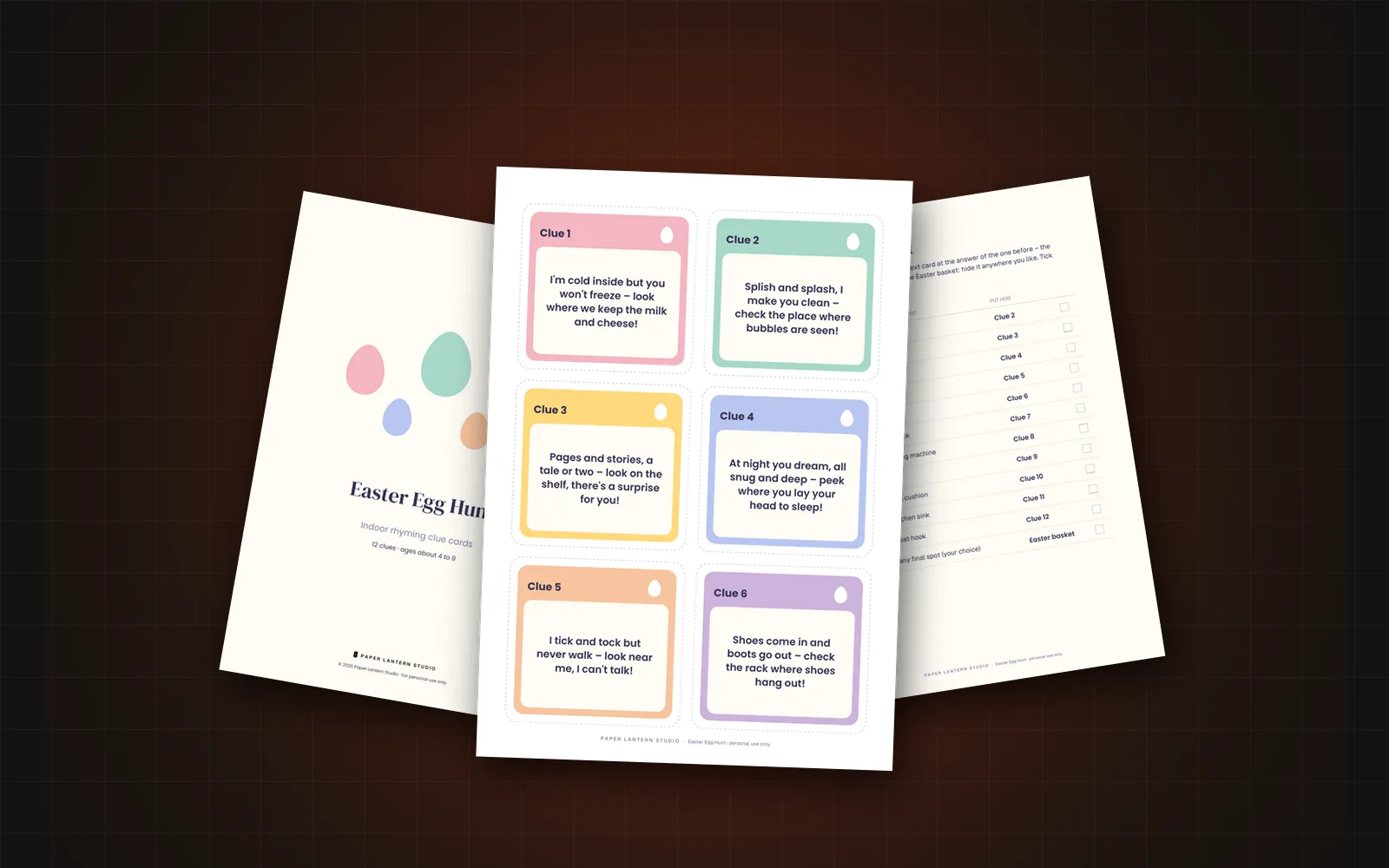
Ready-made clue cards
If you would rather skip the writing, our printable set does the work for you: 12 rhyming indoor clues that form a complete route, 6 blank cards for your own ideas, a parent hiding list with tick boxes and an “Egg Hunt Champion” certificate, in English and German, for A4 and US Letter.